Showing posts with label Climbing Solutions. Show all posts
Showing posts with label Climbing Solutions. Show all posts
Tuesday, February 14, 2012
Climbing gaits flash presentation updated ...
Climbing gaits page was updated with the latest pictures and flash presentation of the gaits.

Wednesday, January 25, 2012
Walloid Dragging Climbing Gait (Fast)

Dragged Gait
Dragging Gait
---

Rotational Gait
Copyright © 2012
Tuesday, January 24, 2012


Sunday, September 25, 2011

Thursday, September 15, 2011

Friday, August 5, 2011
Climbing patterns

Fast climbing with degrees from 0 - 360 degrees

Slow climbing with either upwards and downwards, or right and left
The combination of these two types of climbing can give a combination of very fast climbing plus precise climbing when needed. Also fast climbing method gives robot the chance to move to directions from 0 - 360 degrees.
Thursday, March 3, 2011
Wednesday, January 12, 2011
Meeting with my supervisor Mats Høvin, Summary
Today I met my supervisor Mats Høvin(associated professor at IFI,UiO). Here comes a summary of what he thinks I should be focusing on :

- Handshake protocol. I do not have this protocol & this is something that according to Mats, I better have it implemented in my code
- Zero Positioning. My suggestion to this challenge is to save the current position all the time either at PC side or at the Arduino non-volatile memory.
- Sending data packages back & forth in serial communication would possibly result in loss of data packages. How can my code handle this kind of problems ?
- Error on startup, fix for it ? Is it a programming error, or a hardware error because of Noise on reading inputs from ports ???
- Sending many bytes and the delays resulting by that
- The speed control, should be handled in java or Arduino ??? Maybe fast in the beginning and slow down little by little while reaching the end of the axle
- Play off modus & Should it be target based, or follow every detail from the log blindly ??? Discuss ...
- Camera candidates & streaming , but not image processing -> Intelligent cameras with output ports(how many???) for sending commands to Arduino according to the image processing done by camera itself.
- Using WiFi tech & how ??? WiFly component ?
- Programing a simulator in JAVA (xyz generation and visualization in JAVA)
- PHP/JAVA Applet GUI & Streaming show on website
- Multi Arduino card solutions ? Benefits and disadvantages ??? Discuss ...
- FPGA??? A possible solution instead of Arduino? Discuss ...
- Different methods to read data from encoders, External interruptions or software methods reading encoders value by analogRead() on loop frequence. Discuss based on Atmel/AVR architecture
- Positioning in the room & semi-Kinect sensors
Wednesday, November 17, 2010
Climbing robot, brain storming
This project is an ongoing rapid prototype which is under development by Puya Afsharian & me …
Requirements :
4 x step motor
4 x El. Magnet
1 x Arduino
1 x Thin Aluminium plate

4 x El. Magnet
1 x Arduino
1 x Thin Aluminium plate
Components :
Magnet #1
Magnet #2
Magnet #3
Magnet #2
Magnet #3
Motor #1-1
Motor #1-2
Motor #2-1
Motor #2-2
Motor #1-2
Motor #2-1
Motor #2-2
Algorithm & states :
- Initial state :
Mag. 1,2,3 -> ON
Motor 11,12,21,22 -> OFF - Lift state :
Mag3 -> OFF
Mag 1,2 -> ON
Motor 12, 22 -> CCW ON
Mag3 -> ON - Move Up Right state :
Mag2 -> OFF
Motor 11 CW ON MAX
Motor 12 CW ON -> Vertical(Parallel with chassis)
Mag 2 -> ON - Move Up Left state :
Mag1 -> OFF
Motor 21 CW ON MAX
Motor 12 CW ON -> Vertical(Parallel with chassis)
Mag 1 -> ON

and again to Lift state
Tuesday, August 3, 2010

Friday, July 16, 2010
Thursday, July 15, 2010
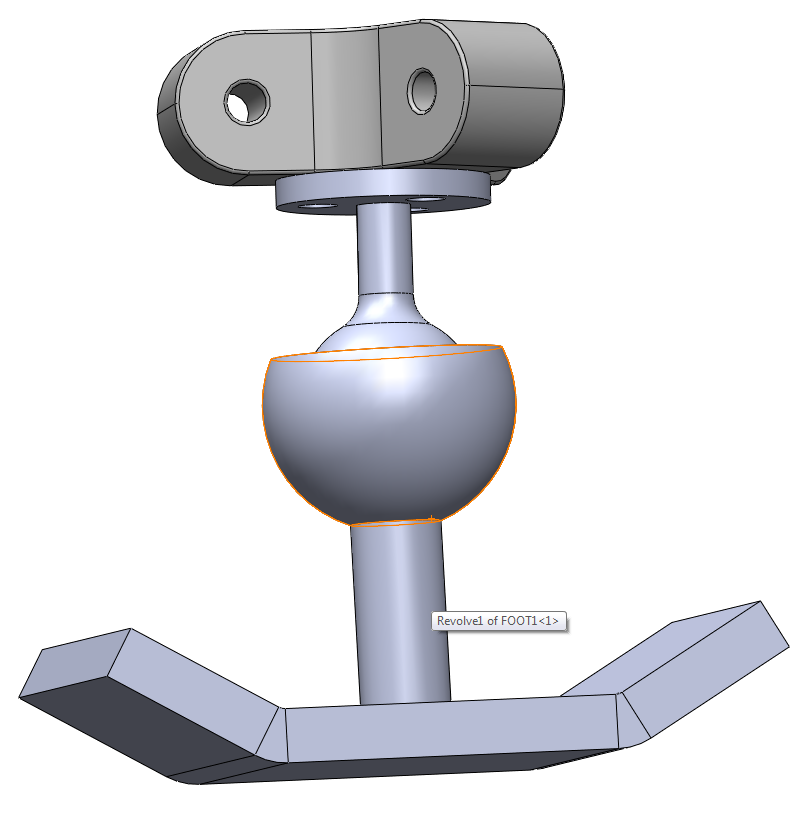
New feet design for walloid
As explained in the previous post, I received new robot design which is under development by Mats Høvin a while ago. While working on a summer-project which is highly related to my master thesis & receiving some tips discussing the new design with some friends*, I came up with some new ideas regarding climbing solutions.
My idea is a very simple grip for each foot which gives the climbing robot the ability to hang on a nail(bolt) on the wall. The curved(bent) part in the middle will be where the robot would grip the nail. I am thinking of using a flex sensor there to receive a signal every time a foot is hanging to a bolt. Meaning if we want to make a move at a time, before moving the foot, we should receive 4 bent resistor signals from the robot feet and while moving, all the way we should be receiving 3 bent resistor signals from other three remaining hanging feet.When we are finished with moving our foot to the new point of griping, we should again receive the 4th signal again ... I am still working on this idea and going to discus it as soon as my supervisor is back from his holiday.
*Thanks to my colleague Tarjei & my friend Magnus :-)
My idea is a very simple grip for each foot which gives the climbing robot the ability to hang on a nail(bolt) on the wall. The curved(bent) part in the middle will be where the robot would grip the nail. I am thinking of using a flex sensor there to receive a signal every time a foot is hanging to a bolt. Meaning if we want to make a move at a time, before moving the foot, we should receive 4 bent resistor signals from the robot feet and while moving, all the way we should be receiving 3 bent resistor signals from other three remaining hanging feet.When we are finished with moving our foot to the new point of griping, we should again receive the 4th signal again ... I am still working on this idea and going to discus it as soon as my supervisor is back from his holiday.
*Thanks to my colleague Tarjei & my friend Magnus :-)


For more snapshots click read more ...
Wednesday, May 5, 2010


Rope Climbing ...
RIWEA: Robot for the Inspection of Wind Energy Converter Rotor Blades
The objective of the project was to develop novel technologies to completely capture the condition of wind energy converter rotor blades. Such state-of-the-art inspection methods as thermography, ultrasonics and high resolution cameras in conjunction with innovative robots make a reliable, objective and integrated analysis of blade condition possible.
Wind energy converter rotor blades must be inspected for damage at regular intervals. Primarily made of glass fiber reinforced plastics, rotor blades are one of a wind energy converter's most highly stressed components.
Source : Fraunhofer
The objective of the project was to develop novel technologies to completely capture the condition of wind energy converter rotor blades. Such state-of-the-art inspection methods as thermography, ultrasonics and high resolution cameras in conjunction with innovative robots make a reliable, objective and integrated analysis of blade condition possible.
Wind energy converter rotor blades must be inspected for damage at regular intervals. Primarily made of glass fiber reinforced plastics, rotor blades are one of a wind energy converter's most highly stressed components.
Source : Fraunhofer
Tuesday, April 27, 2010
Nano Tech, possible solution for Walloid ?
We can clearly see in this test that this kind of nano technology can operate carrying heavy weights(an adult human body). If we can be sure that this solution would operate in wet & extremely cold condition, can't this nano technology be a good start for Walloid ?
Source : Ted.com/talks
Monday, April 19, 2010
Table of Climbing Solutions
Climbing solutions :
| Solution | Pros | Cons |
| Grip, Ring Bolt | Low coast(path), Stable | Path needed, High precision required, Unstable under special condition(under windy situation or even uncalculated torque the robot might loose stability) |
| Grip, Nail | Low coast(path), Very stable | Path needed, Relatively High precision required |
| Nano tech, bio inspiered | Path free, Relatively stable(in case of supported weight) | High coast of producing the material, Question regarding weight issue(Some studies show they are reliable), If functional in extreme cold and wet condition |
| Lock(IKEA type) itself to the wall | Relatively Low coast(path), Extra stable, | Path needed, High precision required |
| Suction cup | Easy implementation, Path free | The path should be totally clear and glossy for the solution to work(unstable and fear of robot to fall) |
| Magnet, pre-path | Low coast(path), Very stable, Path free(Platforms are made of metal variants) | Path needed(depends on the materials that the workspace is made of), Extra power for 4xel. magnets, Unstable in special condition(in case of ice covering the magnet -> in design of platforms up to 10mm ice is considered in calculations) |
| Magnet, path builder | Very stable, Path builder, | Extra arm for path building, Slow, Exact place on the path can not be screwed too many times, Extra power for 4xel. magnets, Unstable in special condition(in case of ice covering the magnet -> in design of platforms up to 10mm ice is considered in calculations) |
| Screw itself to the wall | Extra stable | Exact place on the path can not be screwed too many times, Unstable in special condition(in case of ice covering the magnet -> in design of platforms up to 10mm ice is considered in calculations), |
| ?Glue ? | ? | ? |
Thursday, April 1, 2010
Suction cup solution ...
Suction cup solution for a climbing robot and some early drawings ...

Suction cup solution

suction cups solution climbing stairs
Subscribe to:
Posts (Atom)