Showing posts with label Plans. Show all posts

Thursday, September 8, 2011

Thesis progress

The numbers on the right side are numbers of pages while the numbers in the bottom are the dates.

Monday, August 8, 2011

Nice quote ...

To solve any problem, here are three questions to ask yourself: 
- First, what could I do? - Second, what could I read? - And third, who could I ask?
- Jim Rohn

Friday, August 5, 2011

Bluetooth Technology

Bluetooth uses very little energy !!! They are used in Tsunami detectors (ZIGBEE tech) ...

Advantages
Disadvantages
High throughput
Device discovery is slow in term of power usage and time
Resilience against interference
Keeping connections open is expensive in term of power usage
????????
??????????

Thursday, August 4, 2011

Infrared Technology

Using Infrared for connecting micro-controllers is one of the available choices of wireless intercommunication between micro-controllers. Here is a short list of challenges and the benefits that using such technology would provide us :
Advantages
  • Very low power requirement, hence it is best suitable for machinery with limited battery capacity, like mobile robots, laptops, pads, phones, etc.
  • Inexpensive -> Not a very important issue in designing a revolutionary system. The redundancy is the most important feature.
  • Very secure. The data flow among the source and target is unidirectional, meaning the direction of the infrared beam ensures that there in no leaked or move to nearby devices as it’s transmitted. 
Disadvantages 
  • Data transmission happens in eye sight. -> Meaning you can not have it in a big robot.
  • Short range communication -> Actually this is an advantage in our case, which brings more security.
  • Easily gets interrupted by obstacle  -> Meaning you can not have it in a robot with several layers between micro-controllers. Almost any kind of obstacle interrupt the signal.
  • Not a good choice under extreme weather conditions(sunlight, rain, pollution etc) -> This is the most negative point for this technology not be used in an offshore robot.
Depending on the area of application Infrared might be or might not be the right choice. E.g. the short range of availability would increase our security a lot, while exactly in Walloid project the harsh weather condition is very common in future platforms. Today, there are many technologies exists that are much better than IR like Bluetooth, Wi-Fi etc.

Friday, March 11, 2011

OpenCV & Positioning; Today's focus

Today I'll be focusing on Positioning of a point and OpenCV(Computer Vision) with Processing. I will start to work on positioning and hope to have my first streaming ready by today or early tomorrow morning(before 7:00 a.m.), as I work usually at nights.

Wednesday, March 9, 2011

My status on the 6th day of my holidays that I use for working on my thesis

  • Counter code fixed in Arduino C code
  • Problems with wrong usage of RxTxLibrary(mis match which wasted enough of my time during 6 days ago; unstable connection from Arduino to Java Control System)
  • Java Simulator works fine, just need to finish the fancy java demonstration
  • Logging system works very good
  • Help through HTML file, online
  • Java & Arduino are communicating perfectly
  • Some problems with the prototype feet I have as just one motor functions
  • Working on positioning & zero positioning
  • Safety system for preventing the motor to crash backwards or too much forward

Prevention of motor crash in C, offline Robot


Prevention of motor crash in Java, online Robot, Simulation & Real world


Monday, March 7, 2011

Positioning calculations, Walloid

Update 17.03.2011 : These calculations are totally wrong ... The whole concept is much easier than these things. See the new post about the positioning calculations.
-----------------------------------
Although my supervisor meant that the positioning is happening through very easy geometrical calculation but I struggled a lot to find these equations. I am soon going to code this in my program for Walloid and come up with practical results. I should thank my dear friend Puya Afsharian who helped me a lot in figuring out some of the details.


Saturday, February 19, 2011

Webcam & Processing

Updated, 22nd of February 2011
OpenCV seems to be the perfect tool to do the image processing calculation. A practical example.
---
Hey Shahab,
You should look at the flob library for blob detection. Its listed on the libraries page on processing.org. Its pretty simple to use. Also for better object detection, you might have more luck with openFrameworks, which is c++ based and has a better library for OpenCV.
For my project, I used the flob library and using the OSC protocol (oscp5 library for processing) I sent the data from the webcam to the sound generation program.
Using the OSC protocol you could also use something call openTSPS, by Rockwell Labs, which would be much more easier and exact since its also based on openFrameworks. So sense people with openTSPS and send the data via OSC to your program that controls the micro-controller.
Hope it helps.
Sumit
------------
On Feb 16, 2011, at 3:20 PM, Shahab F. M. wrote:
Hi.
I was wondering if u can give me some tips/tutorial links about webcam & processing. I am working on Walloid as my master thesis.
http://walloid.blogspot.com/
Shahab
Sent from my HTC
Thursday, February 17, 2011

More structured and better plans a head

I need more of structure on coding and planing for my thesis. Things like simple UML diagrams that makes understanding the whole thing much easier. UML diagrams in different levels for different tasks. I also need test scripting to test my code while running it.
will be updated


Thursday, February 10, 2011

Artificial Intelligence

I am taking an Artificial Intelligence course at department of Informatics(INF5390), where Artificial Intelligence - A Modern Approach is the book. Our lecture believes in this book as a bible for AI and this makes it as a good reference in my master thesis as I see LOTS of similarities between what I have done/do/will do and what I learn here in an academic way. I think I can use this source both as an theory back-up for my master thesis and an explanation of my decision making process in my codes.

Wednesday, January 12, 2011

Meeting with my supervisor Mats Høvin, Summary

Today I met my supervisor Mats Høvin(associated professor at IFI,UiO). Here comes a summary of what he thinks I should be focusing on :

  • Handshake protocol. I do not have this protocol & this is something that according to Mats, I better have it implemented in my code
  • Zero Positioning. My suggestion to this challenge is to save the current position all the time either at PC side or at the Arduino non-volatile memory.
  • Sending data packages back & forth in serial communication would possibly result in loss of data packages. How can my code handle this kind of problems ?
  • Error on startup, fix for it ? Is it a programming error, or a hardware error because of Noise on reading inputs from ports ???
  • Sending many bytes and the delays resulting by that
  • The speed control, should be handled in java or Arduino ??? Maybe fast in the beginning and slow down little by little while reaching the end of the axle
  • Play off modus & Should it be target based, or follow every detail from the log blindly ??? Discuss ...
  • Camera candidates & streaming , but not image processing -> Intelligent cameras with output ports(how many???) for sending commands to Arduino according to the image processing done by camera itself.
  • Using WiFi tech & how ??? WiFly component ?
  • Programing a simulator in JAVA (xyz generation and visualization in JAVA)
  • PHP/JAVA Applet GUI & Streaming show on website
  • Multi Arduino card solutions ? Benefits and disadvantages ??? Discuss ...
  • FPGA??? A possible solution instead of Arduino? Discuss ...
  • Different methods to read data from encoders, External interruptions or software methods reading encoders value by analogRead() on loop frequence. Discuss based on Atmel/AVR architecture
  • Positioning in the room & semi-Kinect sensors

Wednesday, November 17, 2010

Climbing robot, brain storming

This project is an ongoing rapid prototype which is under development by Puya Afsharian & me …
Requirements :
4 x step motor
4 x El. Magnet
1 x Arduino
1 x Thin Aluminium plate
Components :
Magnet #1
Magnet #2
Magnet #3
Motor #1-1
Motor #1-2
Motor #2-1
Motor #2-2
Algorithm & states :
  • Initial state :
    Mag. 1,2,3 -> ON
    Motor 11,12,21,22 -> OFF
  • Lift state :
    Mag3 -> OFF
    Mag 1,2 -> ON
    Motor 12, 22 -> CCW ON
    Mag3 -> ON
  • Move Up Right state :
    Mag2 -> OFF
    Motor 11 CW ON MAX
    Motor 12  CW ON -> Vertical(Parallel with chassis)
    Mag 2 -> ON
  • Move Up Left state :
    Mag1 -> OFF
    Motor 21 CW ON MAX
    Motor 12  CW ON -> Vertical(Parallel with chassis)
    Mag 1 -> ON
and again to Lift state

Thursday, July 15, 2010

New feet design for walloid

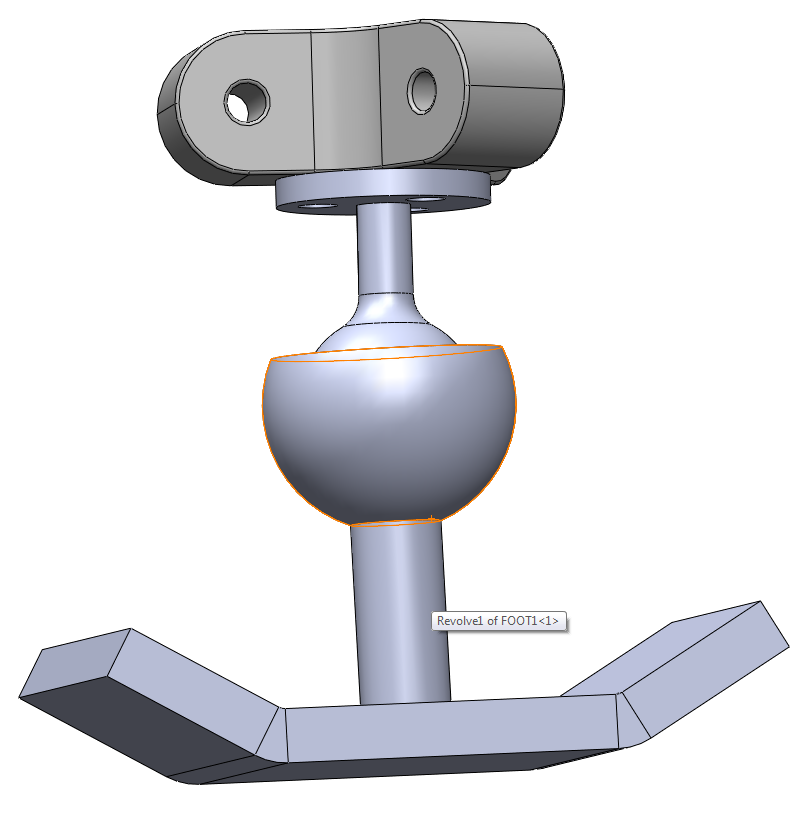
As explained in the previous post, I received new robot design which is under development by Mats Høvin a while ago. While working on a summer-project which is highly related to my master thesis & receiving some tips discussing the new design with some friends*, I came up with some new ideas regarding climbing solutions.
My idea is a very simple grip for each foot which gives the climbing robot the ability to hang on a nail(bolt) on the wall. The curved(bent) part in the middle will be where the robot would grip the nail. I am thinking of using a flex sensor there to receive a signal every time a foot is hanging to a bolt. Meaning if we want to make a move at a time, before moving the foot, we should receive 4 bent resistor signals from the robot feet and while moving, all the way we should be receiving 3 bent resistor signals from other three remaining hanging feet.When we are finished with moving our foot to the new point of griping, we should again receive the 4th signal again ... I am still working on this idea and going to discus it as soon as my supervisor is back from his holiday.
*Thanks to my colleague Tarjei & my friend Magnus :-)


For more snapshots click read more ...

Tuesday, July 13, 2010

LATEST NEWS, Working on summer project which is highly related to my thesis

Right now I am leading a team consist of 7 students, doing a summer-project called Super Crawler(a tank-type robot which roles around with the belt) at Robotica Osloensis(Robotics student community at university of Oslo). My team and I have gained many new experiences(reverse engineering techniques, Programming different motors to work with Arudino boards in C, Communicating with Arduino borads with Java on Serial communication port, signal processing, etc) and have developed  different codes for our purposes. You can read all about it, see the photos & videos and have direct access to our codes on our project worklog. I have also added a RSS-reader on the right side of this weblog about latest news on Super Crawler project ...

These experiences would help me a lot in future development of my climbing robot, Walloid :-)

Monday, April 26, 2010

Possible electronic solution, walloid

The whole idea is based on java program being able to steer the motors through Adruino cards. The java program would be run on an Linux OS on an Eee motherboard. As we have 12 motors for controlling the robot, we would be needing a USB hub with 12 outputs.

Thursday, April 15, 2010

Early Design, Walloid

The hardware design(X2 Module) designed by my supervisor Mats Høvin. I have to start designing the end effector which will contain the solution for climbing.
Source : robotikk.com